
Skip to main content
*Audio in Spanish.
-
Quick3DPlan
-
-
- Tips to download the installer correctly
- How to buy the Quick3DPlan or Quick3DCloset subscription
- How to reset the password in Quick3DPlan or Quick3DCloset
- How to check my program's version
- How to recover a project when the software was closed unexpectedly
- How to download Quick3DPlan for Mac again from the Mac App Store
- How to transfer the license to another computer (*Quick3DPlan 12 and earlier)
-
- ERROR: SetupNew\setup.cpp (140)
- ERROR: File System 0004. : c:\Quick3Dplan/???.dll : curpath=C:/Quick3Dplan
- Feature transfer error
- Runtime Error!
- Error message: “The application has failed to start because its side-by-side configuration is incorrect”
- Error message: “The requested operation requires elevation”
- Error message: “This app can't run on your PC”
-
- How to set up the “3D image detail” level
- How to customize catalog measures in Quick3DPlan
- How to insert your company logo to the impressions
- How to print a “3-view window” of the design
- How to print a photorealistic image or render in Quick3DPlan or Quick3DCloset
- How to print plans and sketches in PDF to be able to send them by e-mail to your clients
- How to print a dimensioned front elevation
-
- How to place a cabinet in a non 90º angle corner
- How to place cabinets, countertops and upstands in a corner with a pillar
- How to simulate a ceiling
- How to fill up a small gap between a cabinet and a non-perpendicular wall
- How to make a wall with different backsplashes
- How to put 2 materials on the floor of the room
- How to create beams in the architecture
- How to shorten a previously inserted partition wall
-
- How to place a cabinet in a non 90º angle corner
- How to place cabinets, countertops and upstands in a corner with a pillar
- How to fill up a small gap between a cabinet and a non-perpendicular wall
- How to apply GOLA type handles to a selected door
- How to erase the handles
- How to insert an L-shape corner with a different door width
- How to make a peninsula or island in the middle of the kitchen with a “breakfast bar”
- How to place a 35-cm folding door cabinet above a refrigerator
- How to place a 60-cm high fridge under a worktop
- How to set the number of drawers in a unit
- How to insert a blind corner for a sink
- How to place 2 rows of wall units with different depths
- How to place a tall cabinet with doors at the top and bottom, and 2 shelves in the center
- How to place a sink unit with drawers instead of doors
- How to put a worktop on top of a dishwasher or washing machine
- How to remove cornices and light pelmets from wall cabinets
- How to extend a cabinet’s countertop to make a “breakfast bar”
- How to adjust the sides to align them with the door
- How to add a plinth to cover the legs of a cabinet
- How to put a “ceiling scribe” cornice
- How to place backsplashes between base and wall units
- How to place a side panel made of the same material as the countertop to create a “waterfall countertop”
- How to insert a corner unit with an upstand in just one side only
- Mostrar artículos restantes (8) Contraer artículos
-
- How to adjust the “Closets module” window to be able to see the lower buttons (in the case they are not visible)
- How to hide the closet doors to see the interior in Quick3DPlan
- How to place a vertical divider that fits in a selected space in Quick3DPlan
- How to reduce the depth of one of the modules to adapt it to a pillar in Quick3DPlan
- How to “simulate” an L-shaped closet, a closet with 2 fronts, or a corner closet in Quick3DPlan
- How to make a “built-in closet” in Quick3DPlan
- How to change the number of modules in cabinets with sliding and swing doors in Quick3DPlan
- How to create “hanging closets” in Quick3DPlan
-
- How to use perspectives in Quick3DPlan or Quick3DCloset
- How to use the option to create photorealistic images or “Renders”
- How to activate the “image history” in the Render window
- How the lights work and how to configure them correctly
- How to show elevations of furniture in narrow kitchens
- How to save a picture of a kitchen dimensioned elevation
- How to change the door, baseboard and worktop colour and material
- How to place a side panel made of the same material as the countertop to create a “waterfall countertop”
-
-
-
Quick3DCloset
-
-
- Tips to download the installer correctly
- How to buy the Quick3DPlan or Quick3DCloset subscription
- How to reset the password in Quick3DPlan or Quick3DCloset
- How to check my program's version
- How to recover a project when the software was closed unexpectedly
-
- ERROR: SetupNew\setup.cpp (140)
- ERROR: File System 0004. : c:\Quick3DCloset/???.dll : curpath=C:/Quick3DCloset
- Feature transfer error
- Runtime Error!
- Error message: “The application has failed to start because its side-by-side configuration is incorrect”
- Error message: “The requested operation requires elevation”
- Error message: “This app can't run on your PC”
-
- How to set up the “3D image detail” level
- How to insert your company logo to the impressions
- How to print a “3-view window” of the design
- How to print a photorealistic image or render in Quick3DPlan or Quick3DCloset
- How to print plans and sketches in PDF to be able to send them by e-mail to your clients
-
- How to change the accessories material
- How to hide the closet doors to see the interior in Quick3DCloset
- How to place a vertical divider that fits in a selected space in Quick3DCloset
- How to create a pocket to adapt the closet to a pillar in Quick3DCloset
- How to “simulate” an L-shaped closet, a closet with 2 fronts, or a corner closet in Quick3DCloset
- How to make a “built-in closet” in Quick3DCloset
- How to create “hanging closets” in Quick3DCloset
-
Published
Updated
ByMicrocad Software
Quick3DPlan – Design Walls with Different Materials
Overview
In this video, we will learn how to assign different materials to a single wall, combining tiles, paint, or other finishes, and how to manage the height and measurements of each material.
1. Prepare the Work Area
- View tab → turn off cabinets, appliances, and accessories
- This allows better work on walls without visual interference
2. Access the Wall Materials Tool
- Photo tab → Wall Material tool
- Click the corresponding button → opens the pop-up window
Editing window includes:
- Wall sketch
- Left-hand list with: material name, height, angle, and measurements
- Initially, the list is empty
3. Add a Material to the Wall
- Click the “plus” icon → select desired finish
- Example: hydraulic-type tile
- Configure parameters:
- Height: 150 cm
- Material size: 15 × 15 cm
- Angle: as needed
- Click OK → the sketch updates
4. Edit Height, Angle, or Material
- Double-click the material → modify height and angle
- Edit button → change type of material or its dimensions
- Add a new material: use the “plus” icon again
- Example: white paint on the upper part
- Click OK → now the wall has two materials
5. Check Total Height and Limits
- Sum the heights of all materials → must not exceed room height
- Example: if 155 + 100 = 255 cm and the room is 250 cm → adjust heights to match
6. Delete Materials
- Select a material → click the “minus” icon
- Material is removed automatically
- To add it again → use the “plus” icon
7. Apply Changes to All Walls or Only One
- Apply to all checkbox → active for global changes
- Checkbox deactivated → changes apply only to the selected wall
- Select wall → click OK → changes applied
8. Finalize the Design
- Turn all elements back on (cabinets, appliances, accessories)
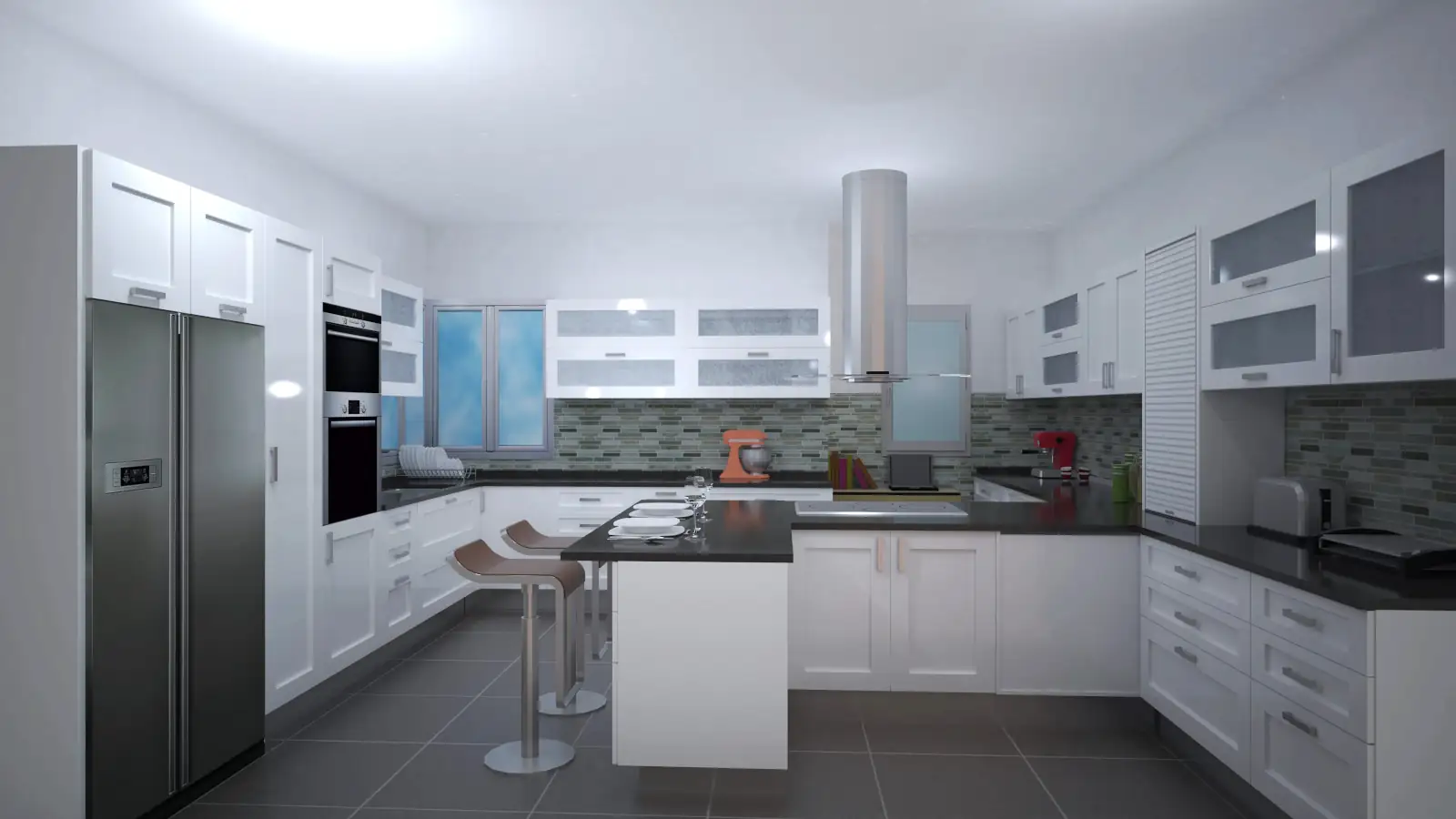
- Obtain a global view of the kitchen design
Note:
This tool allows you to combine materials precisely, controlling the height, measurements, and angle of each finish, achieving customized and realistic walls within the project.
Table of contents